
SPMRM plans to turn wastewater into artificial snow
The fast growing community of Sun Peaks has been attracting new residents, more guests and additional real estate development. But what impact has that had on the local water aquifer? Here’s the fourth and final piece in a series of four in-depth articles regarding the challenges of the water situation in Sun Peaks, made possible only by reader contributions.
Please find the first, second and third stories here.
The municipality has already commissioned preliminary plans for the $13 million project—it’s now waiting for significant grant money to move forward on it.
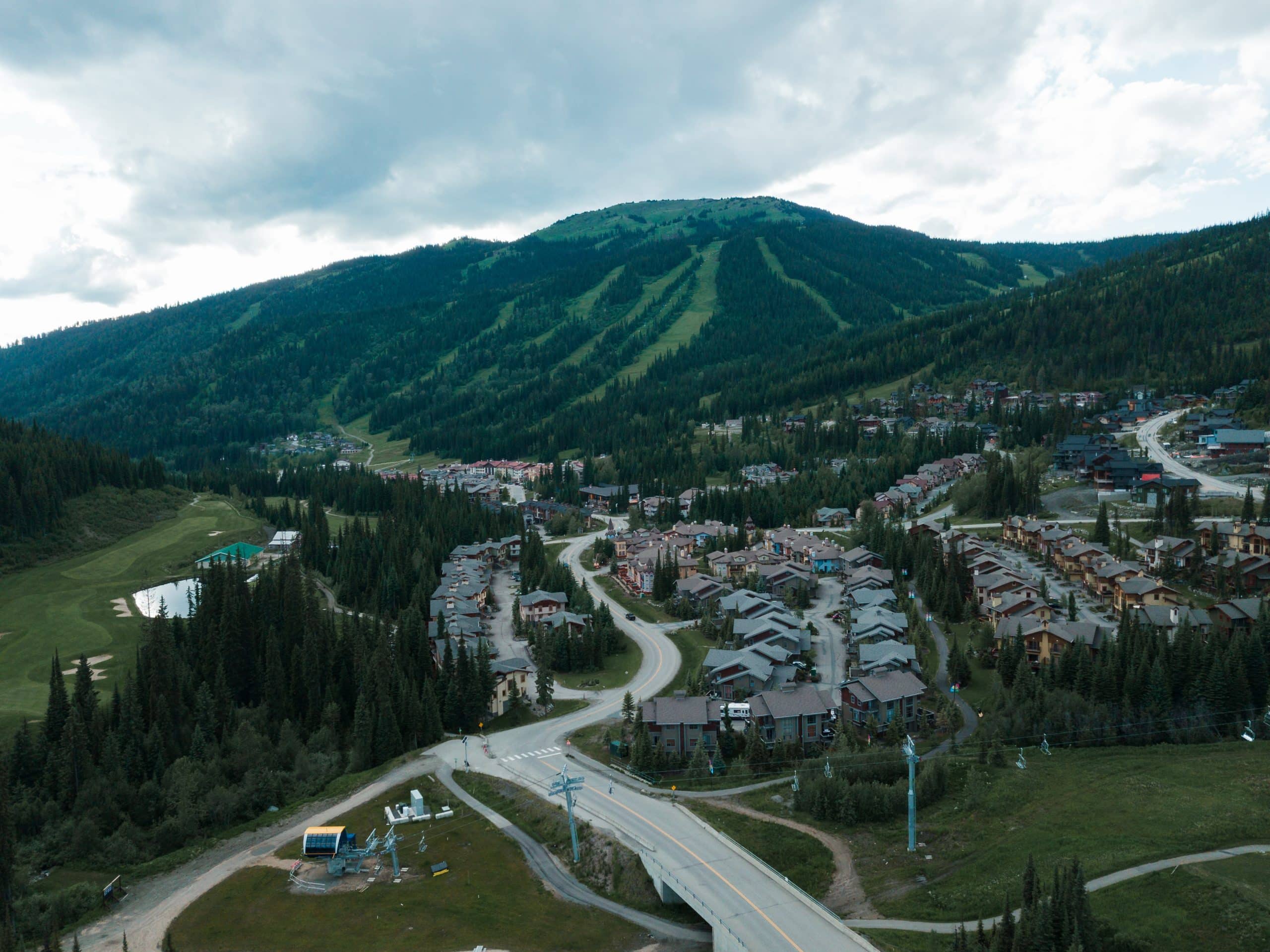
File photo
Going forward, Sun Peaks Mountain Resort Municipality (SPMRM) Mayor Al Raine would like to see the community enact an ambitious project that will give its wastewater a second life.
“Ultimately, what Sun Peaks should be doing is recycle all our wastewater back for future summer irrigation and winter snowmaking,” said Raine. “Water is precious, and just discharging treated effluent into the ground is not acceptable when domestic water is limited in supply and expensive to treat.”
To this end, SPMRM has already completed preliminary engineering work and applied for a grant for a project that would see SPMRM transform the community’s wastewater into artificial snow.
The ambitious, $13-million project—which would be a first of its kind in Canada—would see the construction of several water reservoirs on Mt. Morrisey.

A snowmaking gun begins to blanket the ground in a layer of human made snow Photo Supplied
After being treated to a high standard, a sophisticated pump system would transport the effluent to the reservoirs via a pipeline. From there, Sun Peaks Resort LLP (SPR) would use the liquid to make artificial snow for skiers and boarders to slide down on.
In the summer, the treated effluent would be used to irrigate Sun Peaks’ golf course.
In 2018, SPMRM hired its water engineering firm,Urban Systems, to complete the preliminary planning on the project, at a cost of $22,000.
This was subsequently used to apply for an $11.4 million government grant (the estimated cost has grown slightly since then). The joint federal and provincial government grant would have seen those levels of government pay the lion’s share, 77 per cent ($9 million), of project costs.
SPMRM would have been responsible for the rest, $2,400,300. In a report to council in advance of the application, SPMRM staff stated the treated effluent could also be used to battle wildfires and irrigate the forest to mitigate fire risks during dry periods.
In fall 2019, SPMRM learned that it was unsuccessful in winning the Green Infrastructure – Environmental Quality Program grant.
In an email to SPIN, SPMRM said very preliminary estimates now peg the total cost of the project at about $13 million.
The resort would like to effectively split that cost with SPR, with the municipality covering the cost of the pipeline and pumping stations, while SPR builds the reservoirs.

The current snowmaking reservoir which SPR has shared with SPMRM. Photo Peter Coxon
“We have not finalized any arrangements with SPR LLP at this point, but we propose that the cost of the pipeline and pumping stations as well as the upgrades to the treatment plant would be a municipal cost and the reservoirs would be built by SPR LLP as benefactors of this water supply,” said mayor Al Raine.
“This would have to be a partnership agreement otherwise, the municipality would raise the treatment level and then ground discharge at the appropriate location, no reservoirs.”
An additional $2 million would be needed to upgrade and expand the community’s wastewater treatment plant, added Raine.
With the preliminary engineering work in hand, Raine is hopeful the municipality will be successful with future grant opportunities, saying that the project won’t go forward without them.
Raine added there is also a secondary reason to support the water recycling project: the septic fields that the municipality relies on are now nearly 40 years old, and there is a risk that the effluent that is pumped into them could end up making its way down to Whitecroft.
“Is there a risk? Yes, there is a long-term risk,” said Raine. “So ultimately the best situation is to recycle it.”
The notion of riding down treated effluent may not be what comes to mind when one thinks of skiing or snowboarding, but the practice of using it to irrigate golf courses is fairly common, and carried out in several places in Canada.
Kamloops Golf and Country Club, Rivershore Estates and Gold Links, Predator Ridge, the Vernon Golf and Country Club, The Rise golf course in Vernon and many others take part in the practice.

Other golf courses in the province use treated water on their grass. Photo SPIN
Peter Coxon, an engineer with Urban Systems who has worked on the municipality’s water utility for the past 20 years, is supportive of the Mt. Morrisey project, pointing out that wastewater can now be treated to a level that is drinkable.
When working with new water engineers, Coxon likes to demonstrate a principle of water conservation by holding up a glass of water and pointing out that it could be essentially “dinosaur pee from a million years ago.”
“We have a finite amount of water in our universe, and it just gets recycled,” said Coxon.
SPMRM’s plan is to continue to do preliminary work on the project and apply for grants. So far, it has completed a conceptual design.
“I think there’s a lot to be said for the project,” said chief administrative officerRob Bremner. “To get a fully tertiary treatment system on that side [of the valley] is advantageous to the environment, and the beliefs of the community around the environment and conservation.”
In an email, SPMRM said that it has not yet reached out to local First Nations regarding the Mt. Morrisey project, saying that a referral process would come into play if and when the municipality looks at land use and permitting.
Looking forward, the Mt. Morrisey project is one element of a comprehensive strategy to secure SPMRM’s water security.
SPMRM will spend approximately $6.5 million on the community’s new reservoir, another $4.2 million on a proposed pipeline that will eventually be used to transport water from it, and another $2 to $3 million for a permanent surface water system that will be needed in the near term. Raine said that while he was initially taken aback by the high figures required to shore up and grow the community’s water infrastructure, he has come to accept that the work is necessary for the community, and such infrastructure is costly. Taken together, SPMRM already has around $40 million in wastewater and water treatment assets, he said.
That said, Raine said the municipality will wait for grants before moving on the Mt. Morrissey project.
In the end, he sees this wastewater recycling project as being a valuable one for the community.
“Water is too expensive to be used just once,” he said.
What did you think of this story?
Your feedback after we publish a story helps ensure we're always improving our reporting to better serve you.
Related Articles

Sun Peaks Mountain Resort Municipality updates Official Community Plan
The municipality will host a public engagement session and hearing prior to finalizing the Official Community Plan.
Where to go and what to know: Participating in the 2026 Sun Peaks general election
All the basics of running and voting in the October 2026 general election in Sun Peaks.
Adaptive mountain bike program rolls into Sun Peaks this summer
Adaptive Sports at Sun Peaks is launching adaptive mountain bike lessons, with new equipment and a growing team of trained instructors.