
Five-year financial plan highlights stable, but pressured budget for Sun Peaks
If approved, homeowners will see an 8 per cent municipal tax increase in 2026. The financial plan will go in front of council for adoption on May 12.
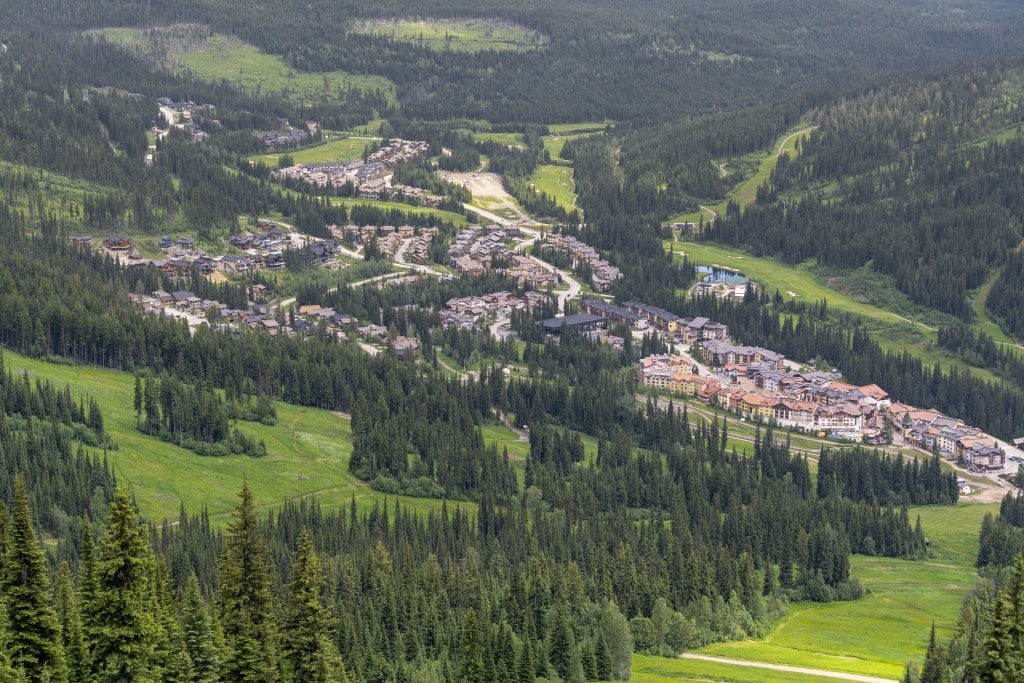
A five-year financial plan for 2026 to 2030 was brought to the public during an April 30 presentation, where municipal director of finance Cheryl Taylor-Gale broke down the intricacies of the budget over the next few years.
The proposed budget, which will go in front of council for adoption May 12 proposes an eight per cent tax increase for 2026 and consecutive years until 2030.
The increase reflects a number of affordability challenges, including ageing infrastructure, lower-than-expected reserves and inflation. It also represents a 5.5 per cent jump from the anticipated tax increase outlined in the previous five-year plan, which set a 2.5 per cent increase for 2026 to 2029.
“Overall, the municipality remains stable, but cost pressures continue to grow,” Taylor-Gale told council during a committee of the whole meeting on April 28.
Annual impacts of this plan will vary depending on property values, but for an average $1 million residential home the proposed eight per cent tax increase will cost an additional $105 per year, or $9 per month. The water rate increases will cost about $21 per month.
The plan received a first, second and third reading on May 5. Those who were unable to attend the public budget presentation can contact Taylor-Gale at dof@sunpeaksmunicipality.ca with any questions or concerns.
Key budget drivers
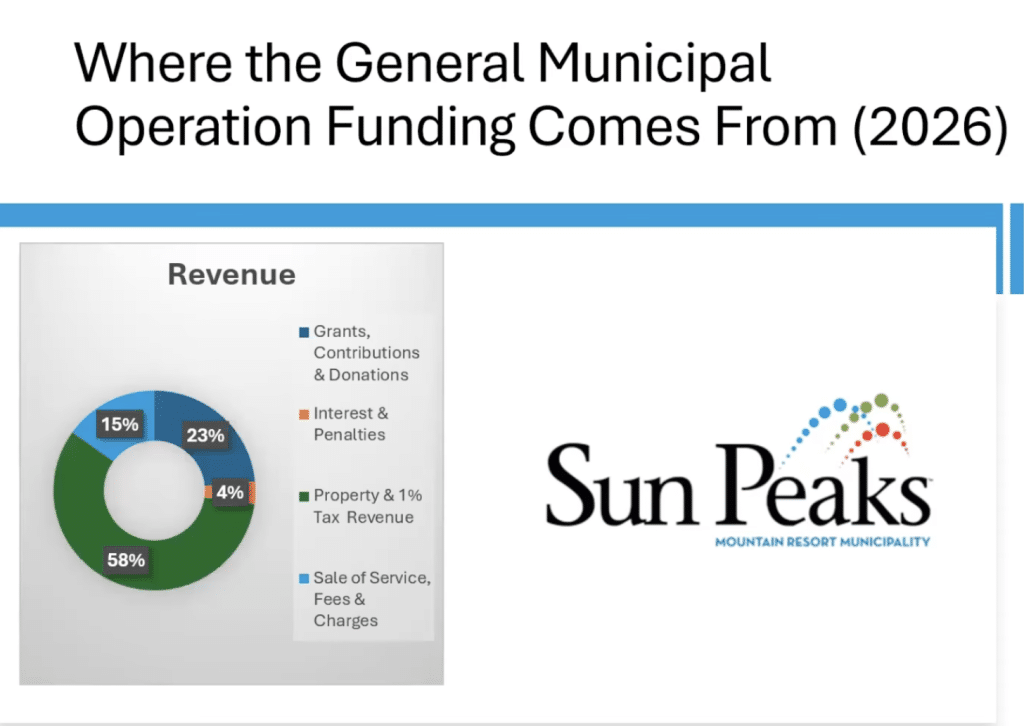
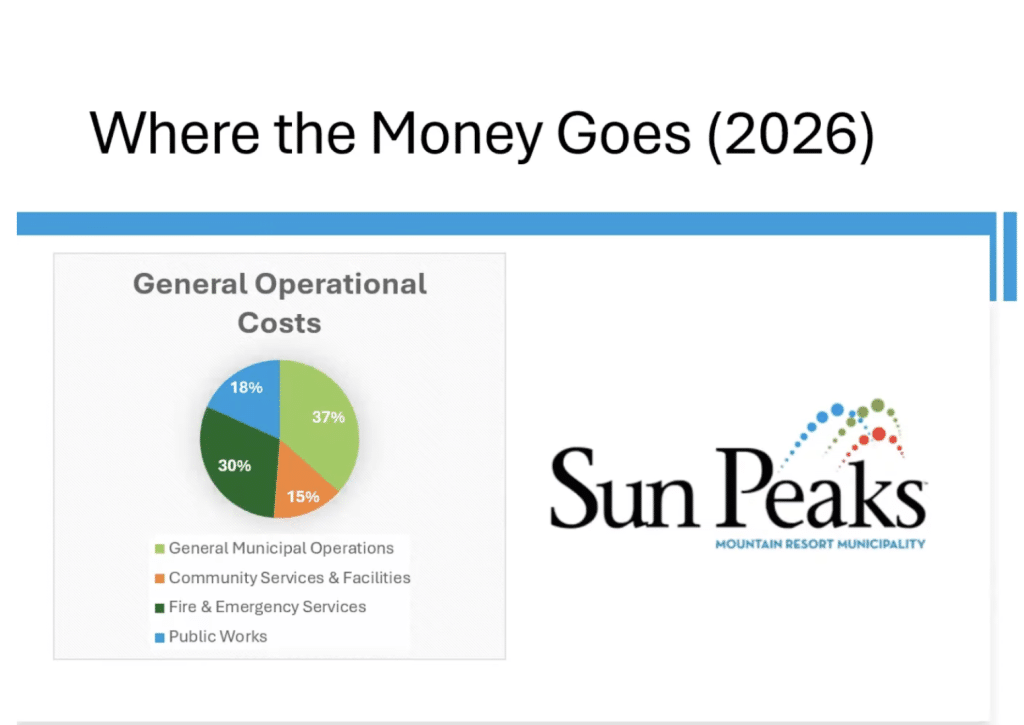
A comparison of revenue streams for the municipality’s operating budget, and how that money is spent. Screenshot via Sun Peaks Resort Municipality/YouTube
The municipality’s operating costs, such as administration, council costs, utilities, vehicles and more, have gradually risen while over the past decade tax increases have been relatively low, Taylor-Gale said.
During the 2016 budget process, it was noted that the municipality kept the total tax package the same for a span of three to four years prior, with an average increase of 1.5 per cent annually.
“We have also relied on revenues that have been unpredictable, such as grants,” Taylor-Gale added. “As a result, some of our long term financial pressures have been deferred and are now becoming more significant.”
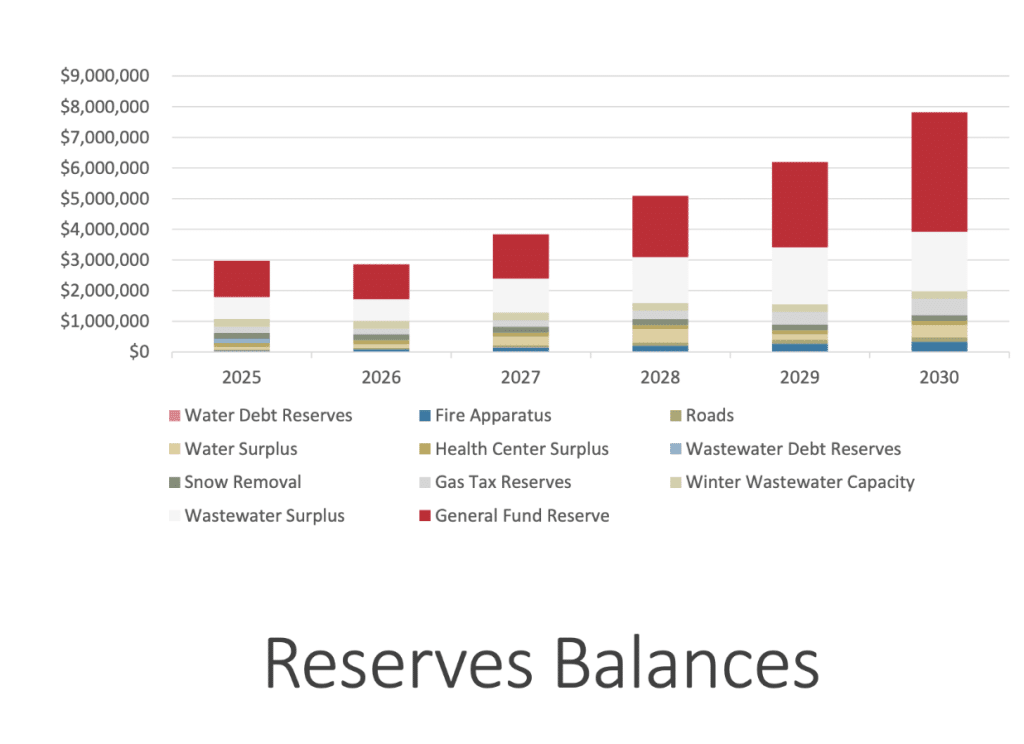
Current reserve levels, or the municipality’s savings, are relatively low at $2.97 million, she added. Additionally, this year the reserves are expected to decrease to $2.48 million as funds are used for projects.
“Rebuilding reserves is a key priority for long term sustainability,” she said.
The three largest expense increases from 2025 to 2026 across operations, water and wastewater are seen in municipal salaries, wages and benefits, long term debt interest and outside services, consulting and labour.
This year, the total revenue for the municipality is increasing by approximately $574,625, primarily from property taxes and grants. Expenses are increasing by about $379,326, driven mainly by staffing, fire services and public works, according to Taylor-Gale.
“Overall, this results in a moderate operating surplus, noting that this excludes debt servicing, capital funding from surplus and any transfers to and from reserves,” she explained.
Capital plan overview
The 2026 general capital budget, the municipality’s budget for purchasing, construction and replacements, is approximately $1.8 million.
Capital investments are earmarked across administration, fire services, public works and the Sun Peaks Centre.
“These investments focus on maintaining existing assets, supporting safety and operational readiness and delivering targeted community improvements,” Taylor-Gale said.
Key priorities include roads and trails improvement, fire service upgrades and improvements to public facilities and public spaces, as well as a supportive housing land acquisition.
The municipality is looking to invest approximately $3.1 million in utility infrastructure, specifically water and wastewater.
“In wastewater, the focus is on treatment, efficiency and capacity, including the centrifuge upgrade and the affluent system improvement,” Taylor-Gale said. “In water, major investments include supply, land, supply line, reservoir expansion and treatment infrastructure, which are critical to meet current demands and future growth.”
Primarily, funding comes from development cost charges reserves, grants, other reserves and surplus, with a “limited reliance on debt,” she added.
Development cost charges were introduced in 2019 to fund growth infrastructure through 2043, with developers paying for the costs associated with expanding utilities and roads to service new development. However, development has been significantly lower than expected, with Taylor-Gale citing the COVID-19 pandemic and the foreign-buyer ban, among others.
During the public budget meeting Mayor Rob O’Toole told SPIN he continues to advocate for an exemption to the foreign-buyer ban.
Specifically, he noted a “productive” conversation with Manjeet Vinning, regional advisor for British Columbia to the prime minister’s office and a letter sent on the municipality’s behalf by the provincial minister of housing Christine Boyle to the federal minister of housing attesting to the growth potential of lifting the ban.
Because of the lower-than-expected contribution to the development cost charges reserves, Taylor-Gale said the municipality is going to rely more on internal borrowing, meaning funds are taken from other reserves to help pay for growth related projects.
“What this tells us is growth is not fully paying for itself,” she simplified. “Most costs are being carried by existing taxpayers and utility users, and we are relying on more reserves and debt to bridge the gap.”
To lessen this impact, Taylor-Gale suggested reviewing and improving the current development cost charges program, and setting aside funds for asset management. Additionally, “identifying a stable and consistent stream of revenue that will ensure all community needs can be sustainably funded over time,” was noted as an area of importance for the 2027-2031 Financial Plan.
During the public budget meeting, chief administrative officer Deanna Campbell told SPIN that while the municipality lacks the legislative ability to implement a tourist tax like in the United States, they are “exploring creative ways,” to seek other funding sources for infrastructure and services from those who use but don’t reside in the municipality.
Looking ahead
Over the next few years until 2030, the projected annual tax increase is eight per cent each year, up from the 2025-2029 Five-Year Financial Plan which estimated a 2.5 increase each year until 2029.
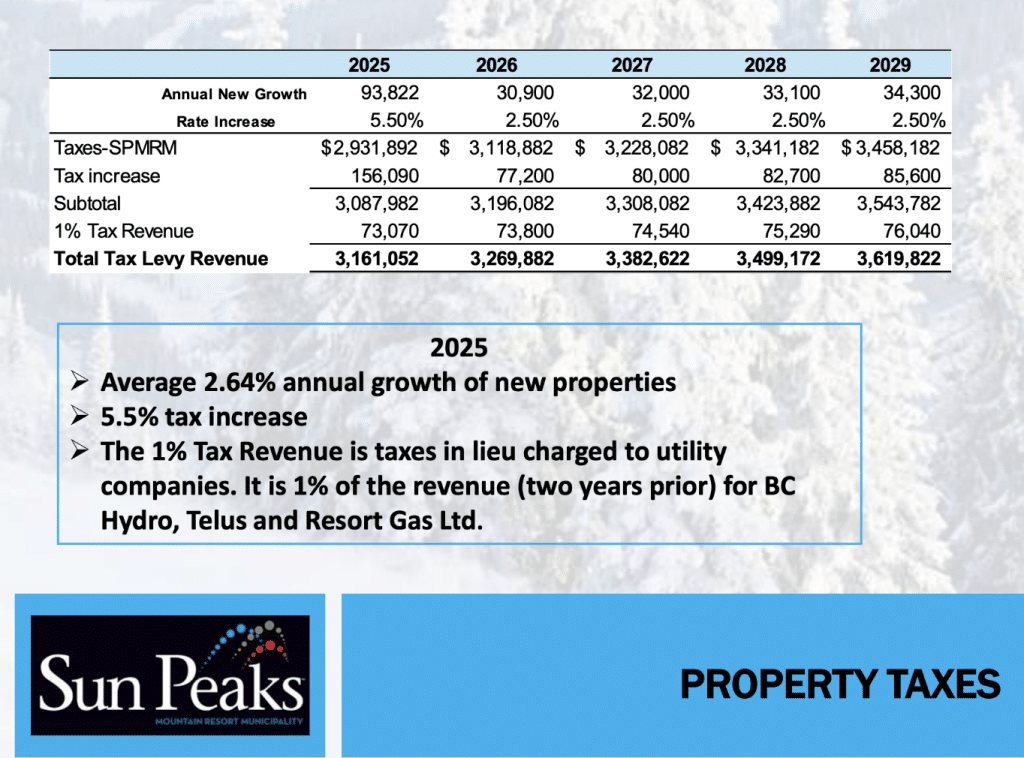
“We revisit our tax increases on an annual basis, based on assessment and the needs, so the five-year plan shows an eight per cent across the board, but when we look at in the future [the tax increase for] 2027-2023 could change,” Taylor-Gale told SPIN during the public budget meeting.
In 2027, continued investment will go into road repairs, drainage work, fire equipment and safety upgrades and select Sun Peaks Centre improvements.
In 2028 spending is slated to be reduced and focused mainly on road maintenance, fire services replacement and completion of remaining facility upgrades. Onwards capital spending is focused on essential renewal, fire equipment replacement and maintaining existing infrastructure.
“The general funding gradually declines and shifts towards a more routine lifecycle based approach,” Taylor-Gale said. “From 2027 to 2030 the utility capital plan focuses on our water and wastewater system, with projects faced based on readiness and available funding.”
Key challenges facing the municipality
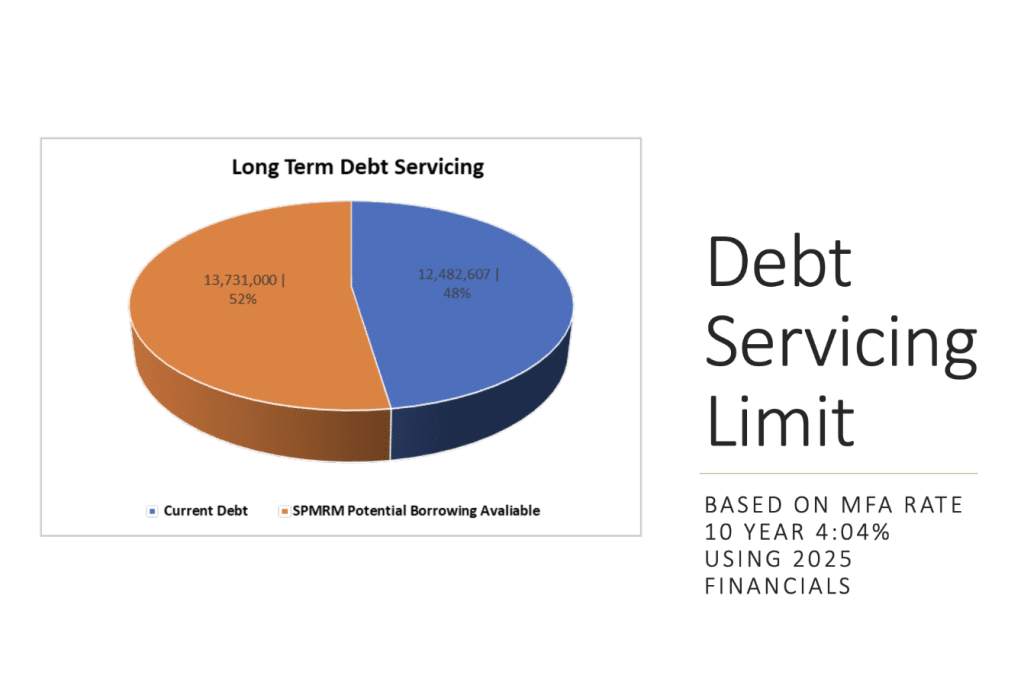
The imperative challenges the budget aims to address is aging infrastructure, low reserve levels and creating sustainable, long term financial strategies.
In the absence of considering the eight per cent tax increase for 2026, risks increase according to Taylor-Gale.
“Infrastructure will continue to age. Future costs will increase. Life service reliability may decline. Online financial flexibility will be reduced. Delaying action increases long term financial tasks.”
Additionally, the municipality currently carries about $12.8 million in debt, and while there is still a borrowing capacity of $13.7 million, any additional debt will increase long term financial obligation.
“Debt will be part of the solution, but it cannot be the only solution,” Taylor-Gale said. “This budget allows us to maintain current service levels, meet regulatory requirements, rising operational costs, and continue servicing existing debt.”
For eligible members, there is a provincial property tax deferment program that allows homeowners to delay paying their property taxes until their property is sold or its ownership changes. For more information and to learn if you’re eligible, visit this website.
What did you think of this story?
Your feedback after we publish a story helps ensure we're always improving our reporting to better serve you.
Author

Related Articles
Sun Peaks adopts new emergency management bylaw
New bylaw formalizes Sun Peaks’ emergency management structure as the municipality works on an updated plan and hazard risk assessment.
Sun Peaks Community Health Association continues work to recruit health-care providers
The Sun Peaks Community Health Association is recruiting multidisciplinary providers and seeking funding, with hopes of reopening within two to three months, president says.
Candidates declared for 2026 Sun Peaks general election
There is one person running for mayor and five people running for council seats in the 2026 Sun Peaks general election.