

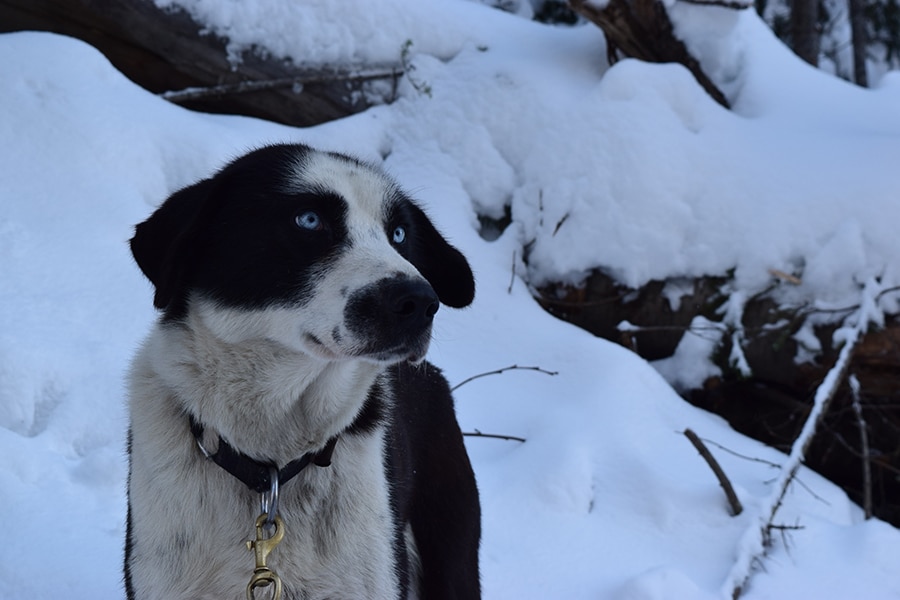
Scout the sled dog was born with two autoimmune diseases; lupus, which affects pigmentation of her skin, and pannus, which will eventually make her blind. Keeping her healthy requires medication, eye drops and trips to a canine eye specialist. With management she is happy, healthy and active.
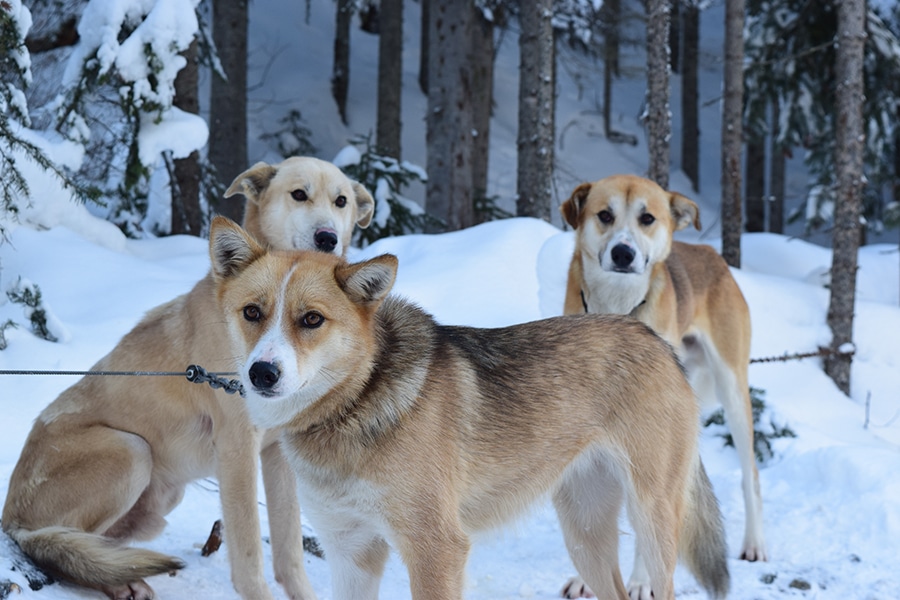
She is one of 60 sled dogs who live at Mountain Man Dog Sled Adventures, Sun Peaks’ only dog sledding operation that has been taking guests on tours for seven years this winter.
Taryn Schwanke, who owns and operates Mountain Man along with her husband Chris, said Scout will go from pulling sleds full-time to part-time this year as she‘s showing less enthusiasm than she used to. Eventually Schwanke will work to place Scout in an adoptive home where she can live out her life getting attention and care.
This winter, in addition to caring for Scout and readying their property and dogs for the season ahead, Schwanke has been busy defending her family operation and her industry after the release of a new documentary about the sled dog industry that premiered at the Whistler Film Festival in December.
Schwanke said “Sled Dogs”, directed by filmmaker Fern Levitt, is not an accurate depiction of the industry in B.C.

“I’m sorry she had a bad experience, I really am. I feel for her,” she said. “But that is not representative of all of us.”

Some in the dog sled industry attempted to have the film pulled from the festival but organizers said it was important to view the film before drawing conclusions. It was awarded the AWFJ Best Female-Directed Documentary Award and tied for the World
Documentary Award.
SPIN was denied permission to view the film, but the trailer shows injured and deceased dogs, dogs being pulled by handlers, dogs standing in mud and more.
It is a striking collection of images that has sparked controversy online with those on both sides speaking out.
The documentary’s trailer, website and director said kennels like Schwanke’s are inhumane. A director’s statement published online said it’s against dogs’ nature to be chained, live outside and run miles with sleds.
Levitt has a number of problems with the industry. She said it’s wrong for operators to make money off of animals, for dogs to be kept on chains or for dogs to be euthanized. She has alleged that culling dogs when they are no longer able to run is common practise and that dogs are mistreated or abused by handlers.
Others, who work alongside the dogs, argue chaining is necessary to care for the animals. At Schwanke’s kennel, located at her family’s home, dogs live on six foot chains with individual shelters.
She said keeping them contained is important to keep them home and it also helps her monitor their health.
She added the dogs are still able to socialize and are moved often to spend time with other dogs. Mountain Man’s dogs also have separate small and large pens for dogs who need a break, medical care or to run and play freely.

After a massive cull of sled dogs in Whistler came to light in 2011, Schwanke and her husband helped create the B.C. Sled Dog Code of Practice, which she said is the minimum standard that all operators should be able to exceed. She said it was important for operators to hold each other accountable as there’s no governing body to enforce the act.
Levitt took issue with the document and said it was not enough. She was especially put off by the fact in contains instructions on euthanizing animals. The section outlines how to humanely shoot a dog if barbiturates and a veterinarian are unavailable and it’s an emergency situation.
When the film’s website was published online it included a list of Canadian operators, including Mountain Man, and encouraged viewers to “do your part to ban these companies and encourage others in your community to do the same”. The list was quickly removed, but it was enough to anger operators who say a few bad operations shouldn’t result in the downfall of an iconic Canadian sport and tourism activity.
Levitt said she had never been to the kennel in Sun Peaks, or spoken with the Schwankes.
Some people involved in the making of the film and other sled operators allege certain scenes were manipulated, staged or taken out of context and that $400,000 in funding through the federal government’s Canada Media Fund used to make the film was obtained dishonestly.
Levitt said all funding was obtained through normal and legal means. SPIN’s requests to view the application were not approved by Canada Media Fund as of printing.
A man featured in the film, Patrick Beall, a musher in the famous 1,500 km Iditarod sledding race, said Levitt was dishonest when asking to film him.
In an email to Levitt shared on his Facebook page Beall wrote, “You blatantly lied to me.” He described Levitt’s camera scaring his dogs and said she only used certain clips to present a negative image of the sport.
Levitt denied any dishonesty while making the film.
“No, no, no, we just filmed, we just filmed,” Levitt said. “I am a documentary filmmaker, I am not a reality TV producer. Exactly what you see is exactly what happened. What you see is what is there.”

An image appears in the film’s trailer showing what appears to be a pile of dead dogs. Many in the sled dog industry were quick to point out it was from the Alaskan property of breeder Frank Rich. In 2012, Rich plead guilty to two counts of animal cruelty and was sentenced to 180 days in jail with a restriction on owning animals after 168 neglected and 19 dead dogs were found on his property.
Levitt confirmed the image was from Rich’s kennel but she believed it still accurately represented the dog sledding industry.
Locally, Schwanke wants to show how much she and her family love and care for their dogs.
“They have everything they need: food, love, shelter, attention, every day of the year,” she said. “The dogs will be fed before us.
“They love to run, they get so excited to run,” she said.
She said anyone who is unsure can visit the kennel and if they are uncomfortable can leave with no obligation. Similarly, dogs who are rehomed will always be welcome to return to the Schwankes’ and can stay while their new owners are away if needed.
She encouraged people to ask questions of the tour operator they choose to use, including about the animals’ care.
“Just watch the dogs, they have an enthusiasm that’s infectious.”
She has received support from the community since the trailer’s release. Local resident and Canadian Senator Nancy Greene Raine recently read a letter in parliament supporting the industry. Schwanke’s veterinarian in Kamloops also supplied a letter stating the dogs are well cared for.
“I have found Taryn and Chris to be caring and conscientious dog handlers, whose empathy for their dogs is not any different than any pet owner that I have met,” wrote Dr. Fergus Alexander, their vet of six years.
This is true for Scout, who has been well cared for by the Schwanke’s since birth. Schwanke is hesitant to let her go to just anyone.
“They will have to visit,” she said. “We love them all so much it’s not an
easy decision.”
Dec 30, 2016 Correction: The original article stated the film trailer showed handlers hitting dogs. This has been corrected to state the film trailer shows handlers pulling dogs.
What did you think of this story?
Your feedback after we publish a story helps ensure we're always improving our reporting to better serve you.